
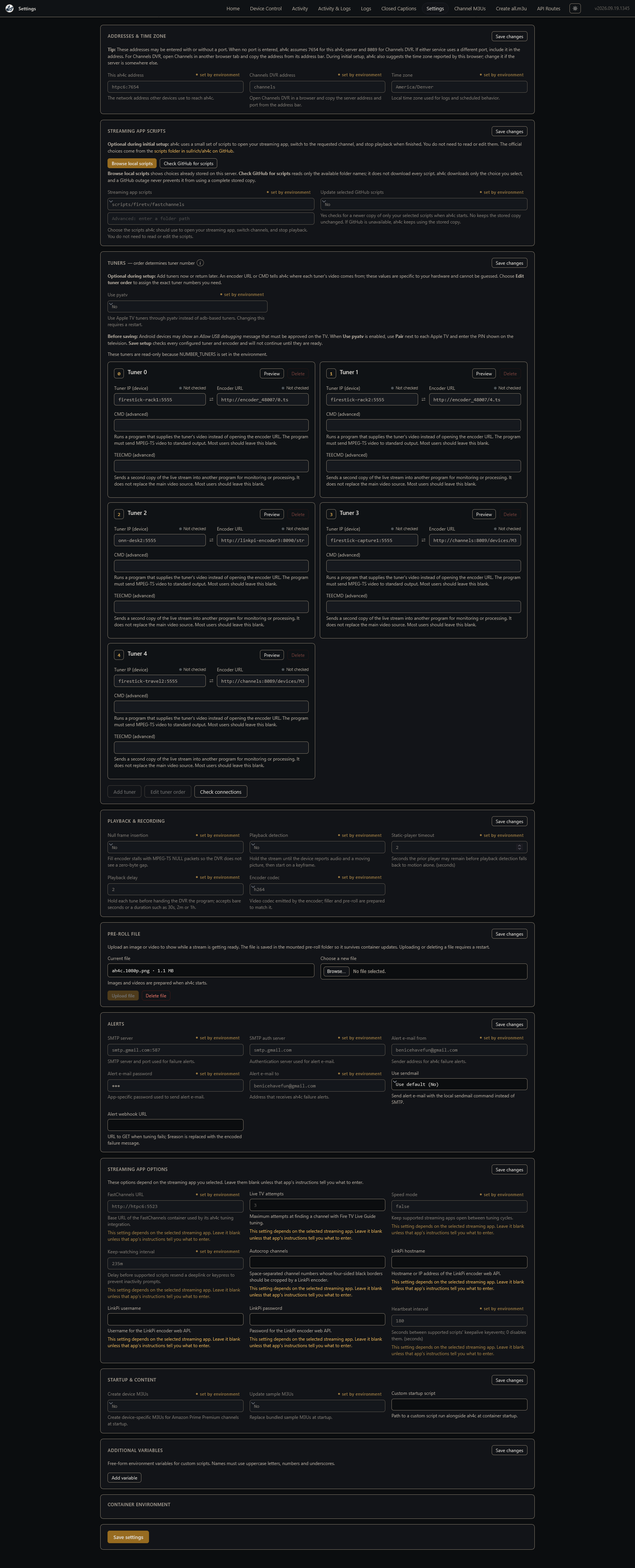
We have a new beta (bnhf/ah4c:beta), for anyone to try who's interested. This is another excellent effort by @mackid1993, including a new in-app settings option (env vars continue to work, and take precedence), along with lots of other new features through the WebUI.
If you'd like to continue to use the "full" Docker Compose (which will require no new configuration on your part), here's the updated version:
services:
  # 2026.09.16
  # GitHub home for this project with setup instructions: https://github.com/sullrich/ah4c
  # Docker Hub home for this project: https://hub.docker.com/repository/docker/bnhf/ah4c
  ah4c: # This docker-compose typically requires no editing. Use the Environment variables section of Portainer to set your values.
    image: bnhf/ah4c:${TAG:-latest}
    container_name: ${CONTAINER_NAME:-ah4c}
    hostname: ${HOSTNAME:-ah4c}
    dns_search: ${DOMAIN:-localdomain} # Specify the name of your LAN's domain, usually local or localdomain
    runtime: ${DOCKER_RUNTIME:-runc} # Closed captions only. Set DOCKER_RUNTIME=nvidia for an NVIDIA GPU with the CUDA engine build. Requires the NVIDIA container toolkit.
    devices:
      - ${GPU_DEVICE:-/dev/null} # Closed captions only. Set GPU_DEVICE=/dev/dri to let the Vulkan engine build use an Intel or AMD GPU. Left at the default it passes /dev/null, which always exists and does nothing.
    ports:
      - ${HOST_PORT:-7654}:7654 # Port used by this ah4c proxy
    environment:
      - AH4C_COMPOSE=2026.09.16 # Compose file date stamp - do not change. The startup log flags it when out of date.
      # ── Proxy identity ──────────────────────────────────────────────────────
      - IPADDRESS=${IPADDRESS} # Hostname or IP address of this ah4c extension to be used in M3U file (also add port number if not in M3U)
      - SETUP_WIZARD=${SETUP_WIZARD:-false} # Full environment-managed installs skip the web setup wizard. Set to true to allow it.
      # ── Tuners ──────────────────────────────────────────────────────────────
      # One trio per tuner: TUNERn_IP is the box to tune; video comes from CMDn if set, otherwise ENCODERn_URL.
      - NUMBER_TUNERS=${NUMBER_TUNERS} # Number of tuners you'd like defined - add a matching TUNERn_IP, ENCODERn_URL and CMDn trio below for each beyond 9
      - TUNER1_IP=${TUNER1_IP} # Streaming device #1 with adb port in the form hostname:port or ip:port
      - ENCODER1_URL=${ENCODER1_URL} # Tuner #1 source URL (http://hostname/stream). Streamed directly when CMD1 is blank; otherwise referenced by CMD1 as ${ENCODER1_URL}.
      - CMD1=${CMD1} # Optional tuner #1 command; ah4c streams its stdout (end it with "-f mpegts -") instead of fetching ENCODER1_URL. No shell.
      - TUNER2_IP=${TUNER2_IP} # Streaming device #2 with adb port in the form hostname:port or ip:port
      - ENCODER2_URL=${ENCODER2_URL} # Tuner #2 source URL. Streamed directly when CMD2 is blank; otherwise referenced by CMD2 as ${ENCODER2_URL}.
      - CMD2=${CMD2} # Optional tuner #2 command; ah4c streams its stdout instead of fetching ENCODER2_URL. See CMD1.
      - TUNER3_IP=${TUNER3_IP} # Streaming device #3 with adb port in the form hostname:port or ip:port
      - ENCODER3_URL=${ENCODER3_URL} # Tuner #3 source URL. Streamed directly when CMD3 is blank; otherwise referenced by CMD3 as ${ENCODER3_URL}.
      - CMD3=${CMD3} # Optional tuner #3 command; ah4c streams its stdout instead of fetching ENCODER3_URL. See CMD1.
      - TUNER4_IP=${TUNER4_IP} # Streaming device #4 with adb port in the form hostname:port or ip:port
      - ENCODER4_URL=${ENCODER4_URL} # Tuner #4 source URL. Streamed directly when CMD4 is blank; otherwise referenced by CMD4 as ${ENCODER4_URL}.
      - CMD4=${CMD4} # Optional tuner #4 command; ah4c streams its stdout instead of fetching ENCODER4_URL. See CMD1.
      - TUNER5_IP=${TUNER5_IP} # Streaming device #5 with adb port in the form hostname:port or ip:port
      - ENCODER5_URL=${ENCODER5_URL} # Tuner #5 source URL. Streamed directly when CMD5 is blank; otherwise referenced by CMD5 as ${ENCODER5_URL}.
      - CMD5=${CMD5} # Optional tuner #5 command; ah4c streams its stdout instead of fetching ENCODER5_URL. See CMD1.
      - TUNER6_IP=${TUNER6_IP} # Streaming device #6 with adb port in the form hostname:port or ip:port
      - ENCODER6_URL=${ENCODER6_URL} # Tuner #6 source URL. Streamed directly when CMD6 is blank; otherwise referenced by CMD6 as ${ENCODER6_URL}.
      - CMD6=${CMD6} # Optional tuner #6 command; ah4c streams its stdout instead of fetching ENCODER6_URL. See CMD1.
      - TUNER7_IP=${TUNER7_IP} # Streaming device #7 with adb port in the form hostname:port or ip:port
      - ENCODER7_URL=${ENCODER7_URL} # Tuner #7 source URL. Streamed directly when CMD7 is blank; otherwise referenced by CMD7 as ${ENCODER7_URL}.
      - CMD7=${CMD7} # Optional tuner #7 command; ah4c streams its stdout instead of fetching ENCODER7_URL. See CMD1.
      - TUNER8_IP=${TUNER8_IP} # Streaming device #8 with adb port in the form hostname:port or ip:port
      - ENCODER8_URL=${ENCODER8_URL} # Tuner #8 source URL. Streamed directly when CMD8 is blank; otherwise referenced by CMD8 as ${ENCODER8_URL}.
      - CMD8=${CMD8} # Optional tuner #8 command; ah4c streams its stdout instead of fetching ENCODER8_URL. See CMD1.
      - TUNER9_IP=${TUNER9_IP} # Streaming device #9 with adb port in the form hostname:port or ip:port
      - ENCODER9_URL=${ENCODER9_URL} # Tuner #9 source URL. Streamed directly when CMD9 is blank; otherwise referenced by CMD9 as ${ENCODER9_URL}.
      - CMD9=${CMD9} # Optional tuner #9 command; ah4c streams its stdout instead of fetching ENCODER9_URL. See CMD1.
      # ── Streaming app and DVR ───────────────────────────────────────────────
      - STREAMER_APP=${STREAMER_APP} # Streaming device name and streaming app you're using in the form scripts/streamer/app (use lowercase with slashes between as shown)
      - PYATV=${PYATV:-false} # Set to TRUE to run docker-start-pyatv.sh at container start for Apple TV tuners via pyatv, instead of the default docker-start.sh used for adb-based tuners. Case-insensitive; anything else runs the default.
      - CHANNELSIP=${CHANNELSIP} # Hostname or IP address of the Channels DVR server itself
      - FASTCHANNELS_URL=${FASTCHANNELS_URL} # Base URL of your FastChannels container, so the firetv/fastchannels scripts can use its built-in ah4c integration to tune. A URL pre-filled into an exported script overrides this.
      # ── Failure alerts ──────────────────────────────────────────────────────
      # Email via SMTP and/or a webhook GET, sent when a tune fails. Leave blank to disable.
      - ALERT_SMTP_SERVER=${ALERT_SMTP_SERVER} # The domainname:port of the SMTP server you'll be using like smtp.gmail.com:587. This is for sending ah4c alerts if tuning fails.
      - ALERT_AUTH_SERVER=${ALERT_AUTH_SERVER} # The auth server for the e-mail you'll be using like smtp.gmail.com
      - ALERT_EMAIL_FROM=${ALERT_EMAIL_FROM} # The e-mail address you'd like your ah4c failure alert e-mails to show as being from.
      - ALERT_EMAIL_PASS=${ALERT_EMAIL_PASS} # Gmail and Yahoo both support the creation of app-specific e-mail passwords, and this is the way to go! It's NOT recommended to use your everyday e-mail password.
      - ALERT_EMAIL_TO=${ALERT_EMAIL_TO} # The e-mail address you'd like your alert e-mails sent to.
      - ALERT_WEBHOOK_URL=${ALERT_WEBHOOK_URL} # URL to GET when an alert fires (same failures that trigger the e-mail); put $reason in the URL and it's replaced with the URL-encoded message. Blank disables it.
      # ── Guide tuning and content updates ────────────────────────────────────
      - LIVETV_ATTEMPTS=${LIVETV_ATTEMPTS} # For FireTV Live Guide tuning only, set maximum number of attempts at finding the desired channel
      - CREATE_M3US=${CREATE_M3US:-false} # Set to true to create device-specific M3Us for use with Amazon Prime Premium channels -- requires a FireTV device
      - UPDATE_SCRIPTS=${UPDATE_SCRIPTS:-true} # Set to true if you'd like the sample scripts and STREAMER_APP scripts updated whether they exist or not
      - UPDATE_M3US=${UPDATE_M3US:-true} # Set to true if you'd like the sample m3us updated whether they exist or not
      # ── Timezone and session handling ───────────────────────────────────────
      - TZ=${TZ} # Your local timezone in Linux "tz" format
      - SPEED_MODE=${SPEED_MODE:-false} # Set to false if you'd like the target streaming app to be closed after each tuning cycle (limited script support).
      - KEEP_WATCHING=${KEEP_WATCHING} # In supported scripts, set the delay before resending a tuning deeplink to prevent "Are you still watching?" type messages. Examples: Use 4h for 4 hours or 240m for 240 minutes.
      # ── Autocrop (LinkPi encoders only) ─────────────────────────────────────
      - AUTOCROP_CHANNELS=${AUTOCROP_CHANNELS} # Space separated list of channels (by number) with black borders on 4 sides to autocrop while maintaining aspect ratio. Requires LinkPi Encoder!
      - LINKPI_HOSTNAME=${LINKPI_HOSTNAME} # Hostname or IP of the LinkPi Encoder's web API. Required for AUTOCROP_CHANNELS.
      - LINKPI_USERNAME=${LINKPI_USERNAME} # Username for the LinkPi Encoder's web API. Required for AUTOCROP_CHANNELS.
      - LINKPI_PASSWORD=${LINKPI_PASSWORD} # Password for the LinkPi Encoder's web API. Required for AUTOCROP_CHANNELS; not currently read by the bundled scripts, which log in with the LinkPi default password instead.
      # ── Custom startup script ───────────────────────────────────────────────
      - USER_SCRIPT=${USER_SCRIPT} # Path to a custom script to run alongside ah4c at container startup. Blank runs nothing extra.
      # ── Recording continuity and playback timing ────────────────────────────
      # Keep recordings starting on the program and free of gaps within the DVR's 30s tune window.
      - NULL_FRAME_INSERTION=${NULL_FRAME_INSERTION:-false} # Set to TRUE to fill encoder stalls with MPEG-TS NULL packets (PID 0x1FFF) so the DVR never sees a zero-byte gap mid-recording. Case-insensitive (true/True/TRUE all work); anything else, including 1/yes, leaves the feature off.
      - PLAYBACK_DETECTION=${PLAYBACK_DETECTION:-false} # Set to TRUE to hold the stream until the device reports audio playing and the picture moving, then start on a keyframe, so recording begins on the program, not the loading screen. Requires adb; network tuners only. Case-insensitive; anything but true leaves it off.
      - PLAYBACK_STATIC_TIMEOUT=${PLAYBACK_STATIC_TIMEOUT} # Only used with PLAYBACK_DETECTION=TRUE. Seconds the box may keep its prior player/session before the check falls back to gating on motion alone. Default 2 suits Ospreys; apps like DirecTV that hold one player across channel changes need more. 0 or unset uses the default.
      - PLAYBACK_DELAY=${PLAYBACK_DELAY} # Hold every tune this long before handing the DVR the program, so a slow-starting app still records within the DVR's 30s window. Black or a mounted pre-roll fills the wait; the box's own video is never passed through. Accepts a bare number (seconds) or a duration like 30s/1m, capped at 10m. Network tuners only. Empty or 0 disables it.
      - ENCODER_CODEC=${ENCODER_CODEC:-h264} # The video codec your encoder outputs: h264 (default) or h265. Filler black/pre-roll must match it, or playback won't cross to the program at hand-off. Pre-roll video is converted to match; an existing H.265 stream is copied. Leave at h264 unless your encoder is H.265. Case-insensitive; h265/hevc both work.
      - HEARTBEAT_INTERVAL=${HEARTBEAT_INTERVAL:-180} # In supported scripts (currently osprey), seconds between keepalive keyevents sent during playback to stop the app's UI inactivity timer from resetting the stream. Default 180; set to 0 to disable.
      # ── NVIDIA GPU ──────────────────────────────────────────────────────────
      # Used by the CUDA caption engine and any CMDn calling h264_nvenc/hevc_nvenc. Needs the NVIDIA container toolkit.
      - NVIDIA_VISIBLE_DEVICES=${NVIDIA_VISIBLE_DEVICES} # For the CUDA caption engine and/or an NVENC CMDn. Set to all alongside DOCKER_RUNTIME=nvidia to expose an NVIDIA GPU. Empty means no GPU and is the default.
      - NVIDIA_DRIVER_CAPABILITIES=${NVIDIA_DRIVER_CAPABILITIES} # Set to compute,utility for the CUDA caption engine. A CMDn using h264_nvenc/hevc_nvenc also needs video - use compute,utility,video (or all).
    volumes:
      - ${HOST_DIR:-/data}/ah4c/config:/opt/config # Settings saved from the web interface
      - ${HOST_DIR:-/data}/ah4c/scripts:/opt/scripts # pre/stop/bmitune.sh scripts will be stored in this bound host directory under streamer/app
      - ${HOST_DIR:-/data}/ah4c/m3u:/opt/m3u # m3u files will be stored here and hosted at http://<hostname or ip>:7654/m3u for use in Channels DVR - Custom Channels settings
      - ${HOST_DIR:-/data}/ah4c/adb:/root/.android # Persistent data directory for adb keys
      - ${HOST_DIR:-/data}/ah4c/captions:/opt/captions # Closed caption settings, and the speech model, engine and any GPU driver downloaded from the Closed Captions page. Stays empty unless you turn captions on
      - ${PREROLL_FILE:-${HOST_DIR:-/data}/ah4c/preroll}:/opt/preroll # A video or still image shown to the DVR instead of NULL packets, during a PLAYBACK_DELAY/PLAYBACK_DETECTION hold or a NULL_FRAME_INSERTION stall. Set PREROLL_FILE to a host path, or drop the file into this directory. Anything ffmpeg reads; prepared once at startup, loops until the real stream is ready
    restart: unless-stopped
If you'd like to have as many options exposed as possible through the new Settings page, then you're going to want to use a more minimal Docker Compose (going this route will require you to set things up through the WebUI that were previously done through env vars).
Here's a recommended Docker Compose for that new minimal route. The Compose itself still requires no editing, but it has a much smaller set of potential env var overrides:
services:
  # 2026.09.16
  # GitHub home for this project with setup instructions: https://github.com/sullrich/ah4c
  # Docker Hub home for this project: https://hub.docker.com/repository/docker/bnhf/ah4c
  ah4c: # This docker-compose typically requires no editing. Use the Environment variables section of Portainer to set your values.
    image: bnhf/ah4c:${TAG:-latest}
    container_name: ${CONTAINER_NAME:-ah4c}
    hostname: ${HOSTNAME:-ah4c}
    dns_search: ${DOMAIN:-localdomain} # Specify the name of your LAN's domain, usually local or localdomain
    runtime: ${DOCKER_RUNTIME:-runc} # Closed captions only. Set DOCKER_RUNTIME=nvidia for an NVIDIA GPU with the CUDA engine build. Requires the NVIDIA container toolkit.
    devices:
      - ${GPU_DEVICE:-/dev/null} # Closed captions only. Set GPU_DEVICE=/dev/dri to let the Vulkan engine build use an Intel or AMD GPU. Left at the default it passes /dev/null, which always exists and does nothing.
    ports:
      - ${HOST_PORT:-7654}:7654 # Port used by this ah4c proxy
    environment:
      - AH4C_COMPOSE=2026.09.16 # Compose file date stamp - do not change. The startup log flags it when out of date.
      - NVIDIA_VISIBLE_DEVICES=${NVIDIA_VISIBLE_DEVICES} # For the CUDA caption engine and/or an NVENC CMDn. Set to all alongside DOCKER_RUNTIME=nvidia to expose an NVIDIA GPU. Empty means no GPU and is the default.
      - NVIDIA_DRIVER_CAPABILITIES=${NVIDIA_DRIVER_CAPABILITIES} # Set to compute,utility for the CUDA caption engine. A CMDn using h264_nvenc/hevc_nvenc also needs video - use compute,utility,video (or all).
    volumes:
      - ${HOST_DIR:-/data}/ah4c/config:/opt/config # Settings saved from the web interface
      - ${HOST_DIR:-/data}/ah4c/scripts:/opt/scripts # pre/stop/bmitune.sh scripts will be stored in this bound host directory under streamer/app
      - ${HOST_DIR:-/data}/ah4c/m3u:/opt/m3u # m3u files will be stored here and hosted at http://<hostname or ip>:7654/m3u for use in Channels DVR - Custom Channels settings
      - ${HOST_DIR:-/data}/ah4c/adb:/root/.android # Persistent data directory for adb keys
      - ${HOST_DIR:-/data}/ah4c/captions:/opt/captions # Closed caption settings, and the speech model, engine and any GPU driver downloaded from the Closed Captions page. Stays empty unless you turn captions on
      - ${HOST_DIR:-/data}/ah4c/preroll:/opt/preroll # A video or still image shown to the DVR instead of NULL packets, during a PLAYBACK_DELAY/PLAYBACK_DETECTION hold or a NULL_FRAME_INSERTION stall. Set PREROLL_FILE to a host path, or drop the file into this directory. Anything ffmpeg reads; prepared once at startup, loops until the real stream is ready
    restart: unless-stopped
And, here's a sample set of overrides for the minimal Compose:
TAG=beta
GPU_DEVICE=
HOST_DIR=/data
Here's what the new Settings page looks like:
Many thanks to @mackid1993, and I'm sure he'll add a post expanding on all the new features available through this beta.
