Connected to Internet but all browsers say I'm offline

Let me describe what just happened.

I'm remoting into my home network and from there I'm remoting to the Channels host server. A show that was scheduled to record under the DVR tab was failing, so I deleted the error message and navigated to the TVE show in the guide and clicked on "Watch Now". After trying to connect for about 10 seconds it failed and I repeated the process. After repeating this for several minutes, on about the 10th attempt it locked onto the stream and began remuxing and then playing in the browser's player window and I chose to "Record Again". It began recording and I expect it to record about 5 or 10 minutes and then simply abort the recording (maybe due to inability to keep the stream alive and just giving up). This happens over and over again in my experience when I'm having issues, because I AM getting unpredictable spontaneous periods of connection even in the midst of the problem.
While I was typing the message the recording had already stopped and does not try to resume.

pinging IP addresses when you have the problem will show if it's a connectivity problem or DNS problem.

That definitely sounds like a DNS problem.
Is everything on your network using your Netgear router for a DHCP IP address and DNS server IP address?
Make sure your DVR server PC is set to get a DHCP IP lease and DNS server IP's from your Netgear router and that your Netgear router is acting as the DNS server for your LAN and that the Netgear router is using the Internet DNS servers you want (1.0.0.1, 1.1.1.1).

Everything on my LAN uses this default gateway 192.168.1.1 and DNS server IP 192.168.1.1 which is my router.

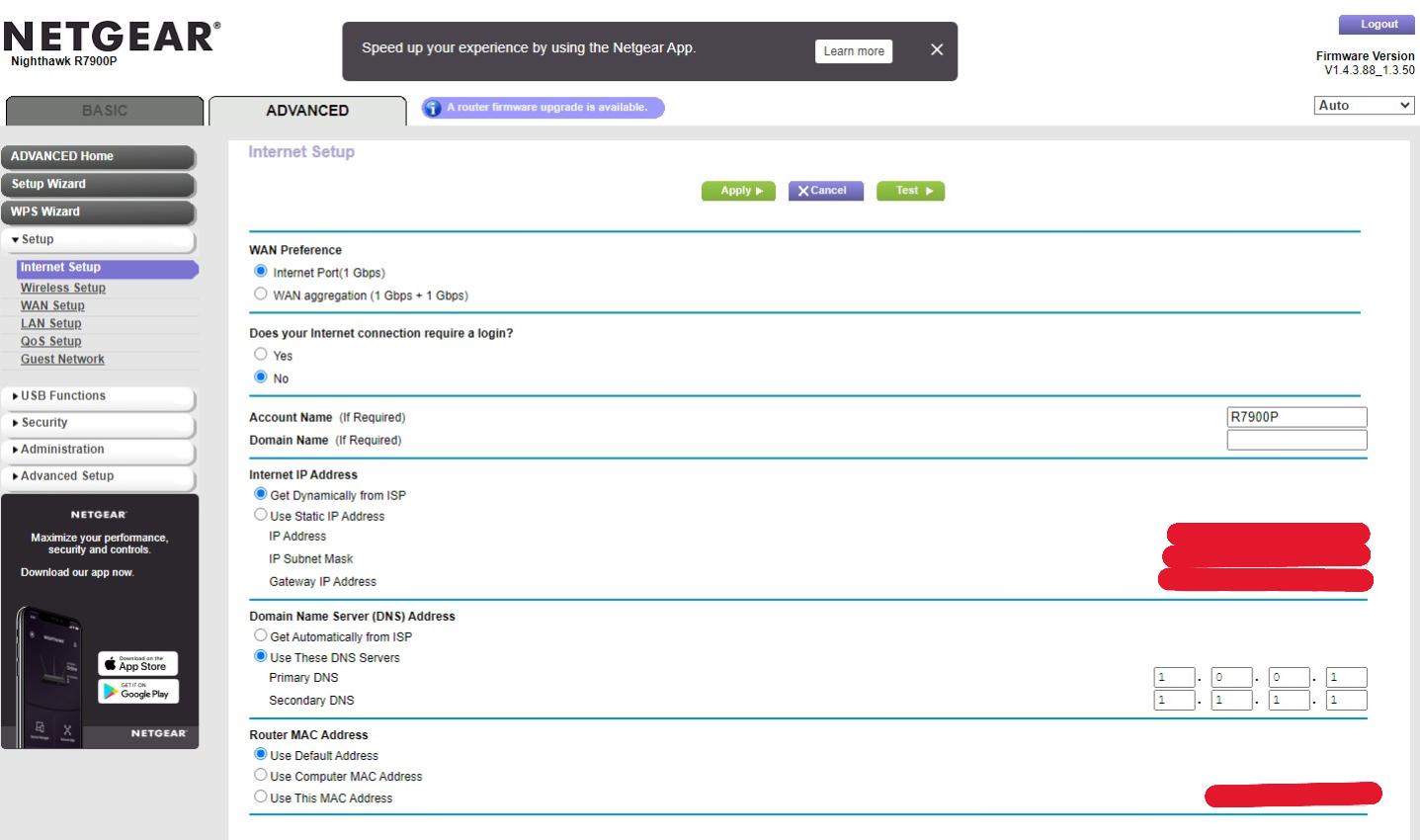
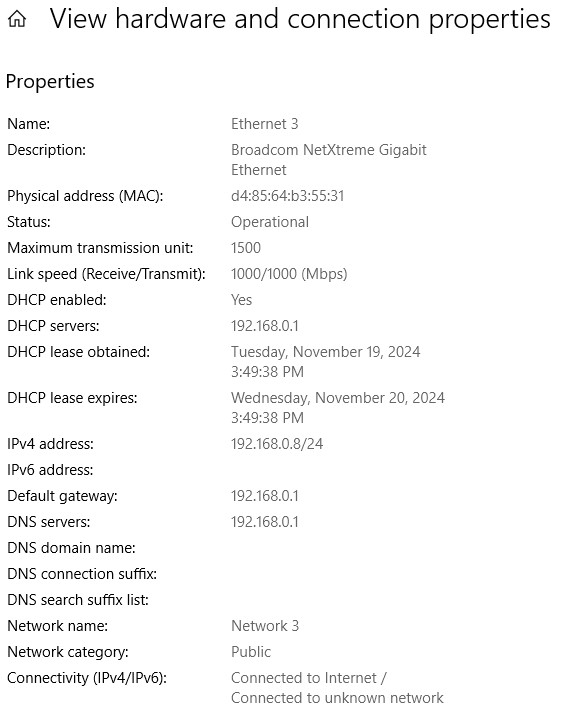
Here's the Internet setup on my router (LAN setup doesn't show DNS) and the Network settings on the Channels Server (Windows 10)


Note that I swapped the primary and secondary DNS servers

192.168.0.1 is the LAN IP of the router.

They're promoting this concept of a "Bomb Cyclone" hitting the PNW and our Building had a very unconventional "power outage" at 3 so we sent everyone home. When I got home I shut down the Channels host PC, unplugged the router and the modem and then plugged them all back in after about 20 seconds. When the Channels PC came back up it immediately began recording the TVE program it had given up on (it wouldn't have done this without the power cycle) and all networking was functioning properly again.

Maybe I need to find a way to schedulte these kinds of "resets" so it can be handsfree...

Your setup looks fine.

Did you change the default IP address of the router from 192.168.1.1 to 192.168.0.1?

Noticed your Nighthawk firmware isn't up to date. The newest version for it was released two years ago. Since your router is exposed to the Internet, I would update the firmware to the latest version. If there are known security vulnerabilities it fixed two years ago, I'm sure they're being exploited in unpatched routers. R7900P Firmware Version 1.4.4.94 - NETGEAR Support

And if yours is a R7900P version V1, it's an end of service product and won't get any new firmware updates.

I'm wondering if you have two DHCP servers active on your network. The next time this happens, display the IP configuration of the computers having the issue. We need to see the following:

DHCP server that provided the lease
The IP address assigned
The gateway assigned
The network mask assigned
The DHCP server(s) assigned

Also tell us the IP of your router when this happens.

As your computers seem to be getting out over the router, you might want to manually assign the DNS server for your channels server and any other critical host. As you like Cloudflare, use 1.1.1.1 as primary and 1.0.0.1 as the secondary.

1 Like

I was thinking either that, or the apps NETGEAR ARMOR and CIRCLE SMART PARENTAL CONTROLS running on the router (not sure they can be disabled).

I had a D-Link DIR-825 router using that IP I was replacing and it was just easier to change the router's address to 192.168.0.1 than to go to all of our connected devices and change the gateway address on them.

When I switched over from pfSense running on a Linux PC to the router, I did a factory reset on the Netgear router and installed what was the current firmware at the time. In August 2023 I attempted to update to the latest firmware and the installation didn't complete, so I rolled it back to the one that was before it. Since then I haven't bothered to try again because I was very busy with other things I deemed more important.

I have a Netgear Arlo security setup that uses its own wireless router and is hard-wired into one of our home network's switches and given an address reservation at 192.168.0.101 by the gateway router. I imagine it connects to its wireless cameras using its own DHCP service but I'm not sure I can confirm that.

And I just remembered that I'm using the old D-Link router as a switch (in Access Point mode) in the master bedroom to service a TiVo and a Smart TV (so rarely used I actually forgot about them). Curiously, though, I don't see an attached device that looks like the D-Link but I do see the TiVo and TV that are plugged into it, so that tells me it is indeed acting as a switch.

This is an overly broad statement. It’s completely possible depending on the isp router for a router in bridge mode to cause a double nat. For example the bgw320 from AT&T causes a double nat. Even though the router is in bridge mode you are a hostage to the bgw320 ip tables as well.

To the OP have you tried testing with just the isp router without bridge mode, taking your nighthawk out of the equation?

I was talking about the Xfinity xFi Gateway specifically

That would be a great idea if I would discover the issue quickly, but the history has been that it often takes up to a week or more for the problem to show up. That would be overly disruptive to the interconnectedness of all the wired devices.on our LAN just to confirm what I'm already 95 percent sure of. With the modem having just been replaced and the old outdoor wiring being all new now, I think that my symptoms appear to be consistent at disparate physical locations on the network, it makes the ethernet cable from the modem to the router and the router itself the next mostly likely suspects.

I've considered just buying a newer version of a similar-type router, but I'm also debating the merits of going back to pfSense with a mini-PC or for simplicity a Netgate 1100 or 2100. pfSense was more complex to set up because of all the functionality it provides, but it was always rock solid the way we had it set up.

Actually, when I was pinging, I noticed that there was more latency with 1.1.1.1 than there was with
8.8.8.8, so I might try that with just the Channels host PC. For some reason I didn't think that was an option - to essentially bypass the gateway for DNS? For the PC's adapter settings, I had always set it to obtain DNS server address automatically. If I change it to Use the following DNS server addresses, can I set the preferred for Google (8.8.8.8) and the alternate to Cloudflare (1.1.1.1)? Does that ignore the settings on the gateway?

Edit: Okay, I've changed the network adapter settings to use the DNS addresses 8.8.8.8 and 1.1.1.1 and got great troubleshooting test results both for the Windows network and for Channels. I'm looking forward to seeing if this makes a big difference because I think it might.

If you wish to use Google DNS then use 8.8.8.8 and 8.8.4.4

The providers provide geographic and network topology optimized redundancy. Using two different providers has lower reliability and can lead to inconsistent results

2 Likes

Good to know about the primary and alternate DNS being from the same provider. I havent been able to do much because we've had no internet at the house since late Tuesday and are still waiting.

Anyone know how to override the clock on a Tivo Bolt without internet? Ive got one on a OTA antenna and would like to record a couple football games but the TiVo thinks it's late Thursday evening right now and shows the guide and program information accordingly. A manual record will have that false information imbedded in it also.

Some routers will allow you to connect a cell phone. Another option is to add a wireless bridge and have it tethered to your phone and connected to the WAN port of your router.

I manually assigned 8.8.8.8 and 8.8.4.4 in Change Adapter Settings for the Channels server and I have not had a single issue - knock on wood - since our internet was restored Tuesday morning. This may have been the best "solution".

I just wish I knew why it works from the individual PC and not from the router. The only thing I can think of is that the D-Link router has an internal IP of 192.168.0.1 by default and I've changed the Netgear router (LAN gateway) to use that IP. I assumed that the D-Link router in "Repeater Mode" would not interfere as I access its user interface using the IP assigned to it by the Netgear router and any client would do the same.

This topic was automatically closed 30 days after the last reply. New replies are no longer allowed.