Organizr for Channels: A Single Browser Tab for All Your Channels DVR WebUIs

For those of us that use multiple different Channels DVR extensions, it's easy to end up with lots of different browser tabs open related to Channels. With Organizr, you'll have a single browser tab to open, and then all of your Channels DVR related stuff will be available to launch down the left side.

The Organizr container is a great way to deal with this, and is an excellent example of something that was a bit of a PIA to setup in the bad-old-days before Docker and Portainer. :slight_smile:

Here's and example of how I'm using it with a Proxmox Container I have setup that runs Docker, Portainer, Cockpit (w/Navigator) and all of my Channels extensions:

Looking down the left edge you can see I have:

  • Portainer
  • Cockpit (w/Navigator)
  • Channels DVR
  • Single-Port HDMI Encoder
  • Multi-Port HDMI Encoder
  • ah4c (formerly androidhdmi-for-channels) two vTuners setup for DirecTV
  • ah4c2 two vTuners setup for Prime Premium Video Channels
  • ah4c3 one vTuner for development
  • ADBTuner
  • Scrcpy to access FireSticks used with ah4c
  • Scrcpy2 to access FireSticks used with ah4c2
  • Scrcpy3 to access FireStick used with ah4c3
  • OliveTin-for-Channels
  • Organizr Settings

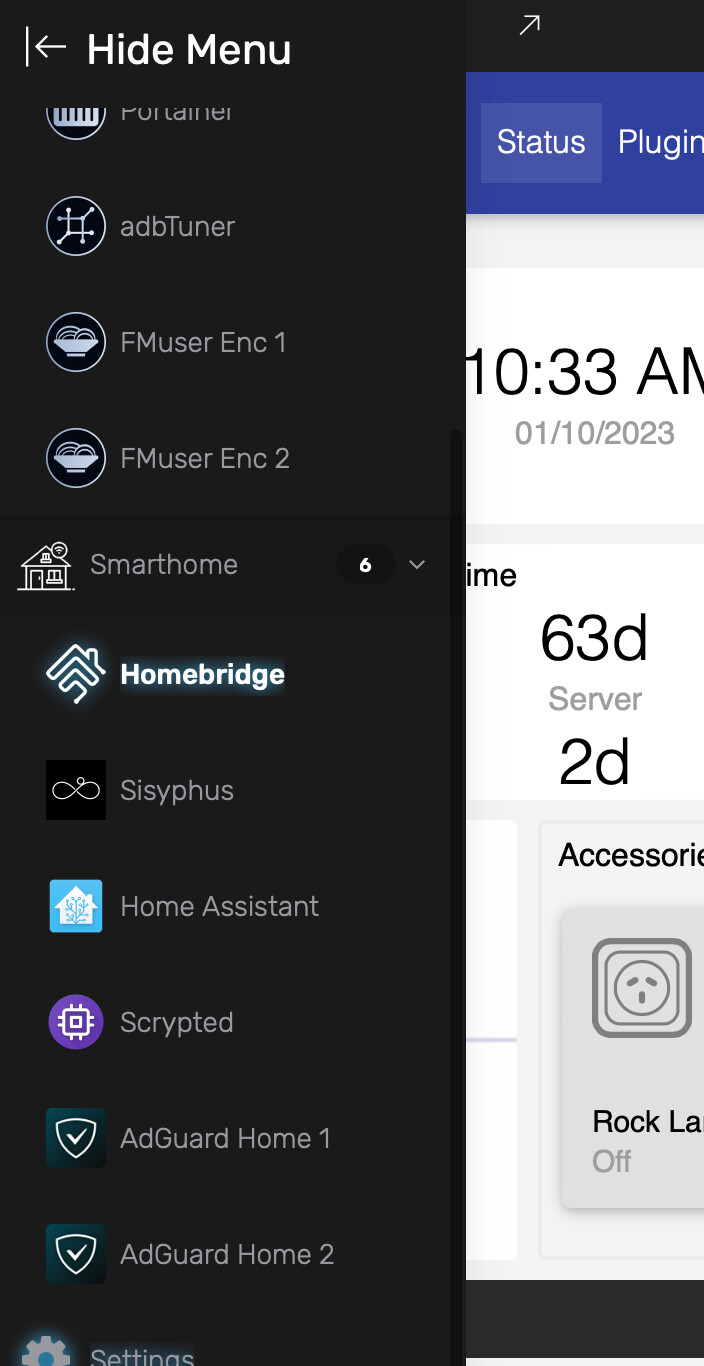
It has a pop-out side menu, when you hover over it, which is great when you're using the same icon for multiple things. Here are some examples of how this looks with various extensions and useful companion programs:

Portainer:

Cockpit:

HDMI Encoder:

ah4c:

ADBTuner:

ws-Scrcpy:

ws-Scrcpy (connected to FireStick):
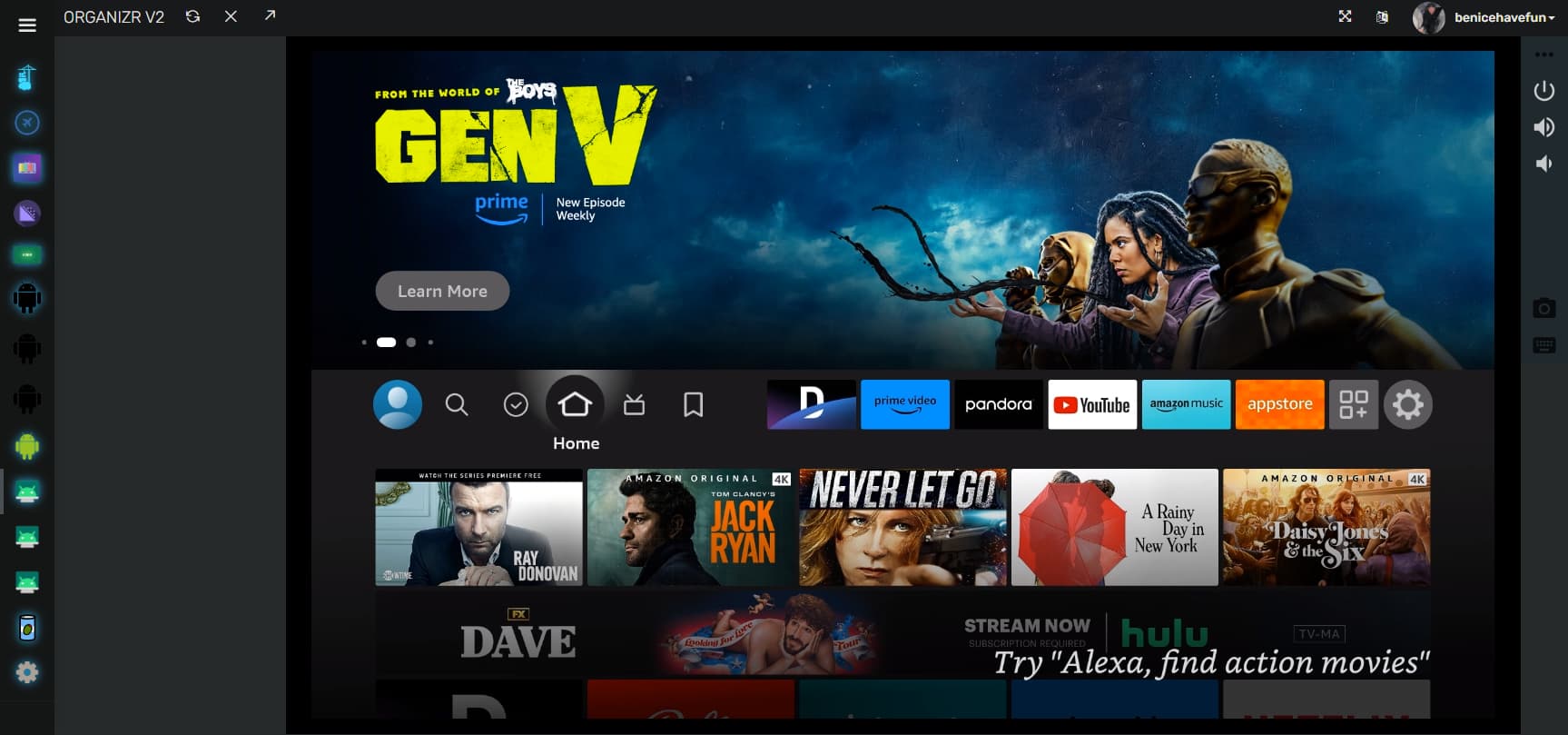
OliveTin-for-Channels:

For those that this sort of thing appeals to -- here's the docker-compose for use in Portainer-Stacks:

version: '3.9'
services:
  organizr:
    image: organizr/organizr:latest
    container_name: organizr
    hostname: organizr
    ports:
      - 80:80
    environment:
      - PUID=nobody
      - PGID=nobody
      - TZ=${TZ}
    volumes:
      - /data/organizr:/config
    restart: unless-stopped

Once you've spun-up the container, you'll find Organizr running on port 80 -- so for me, I get there by going to http://htpc6. Yours will be at whatever hostname (or IP if you must) your Docker host uses.

After going through the basic setup, you'll want to go to the Tab Editor page in Organizr and add the details for your WebUIs:

And basic details to setup a tab:

Organizr will work with both http: and https:, but it's at its best with http: as the pages will typically load in iFrames, as opposed to opening a new browser tab -- which kind of defeats the purpose. Never expose Organizr to the Internet directly, but it works great with Tailscale to have access wherever you happen to be.

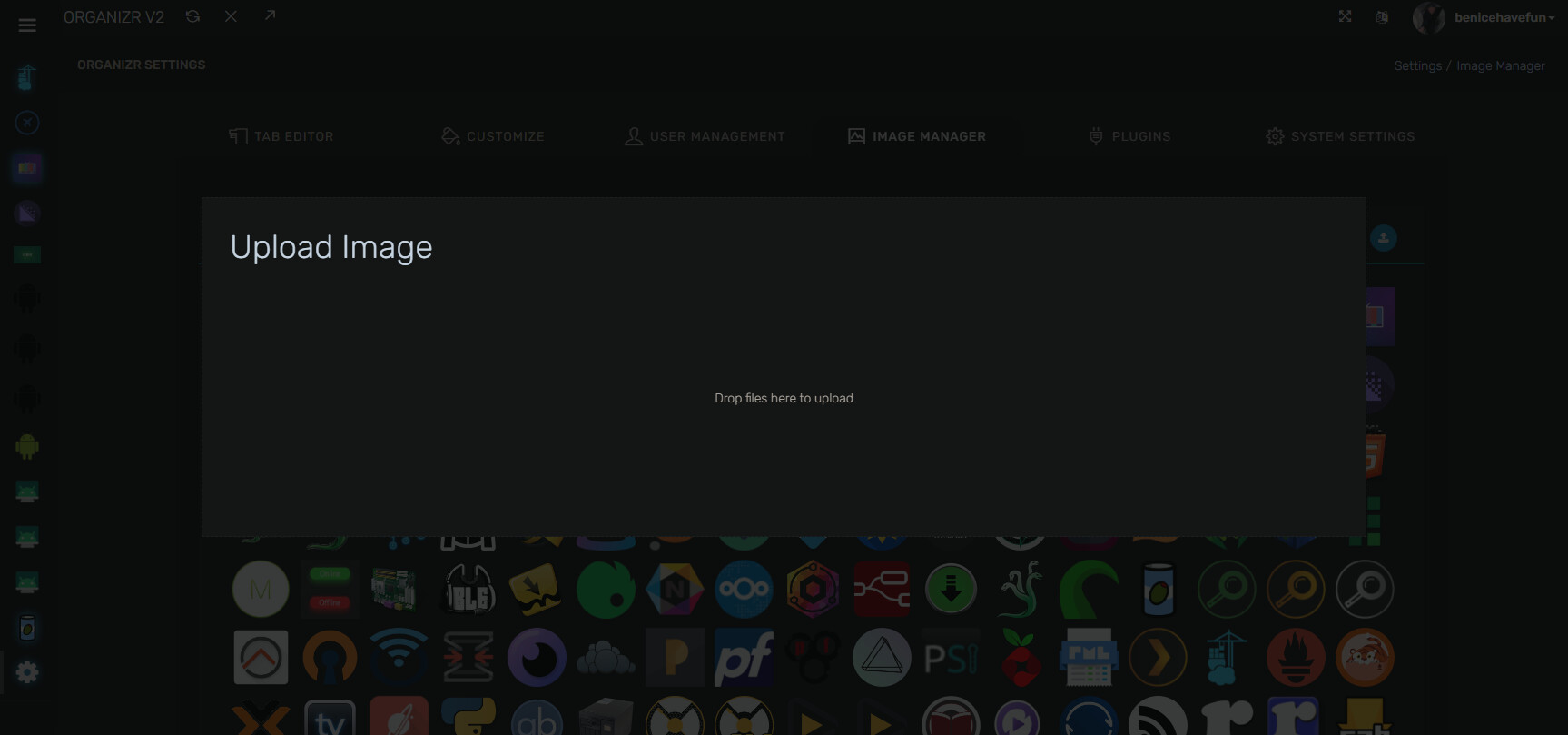
As far as icons go, Organizr has a lot of them for popular packages, but if there isn't one for yours use the image editor to add it.

1 Like

This is beautiful! I just deployed Organizr, added all of my CDVR server admin bookmarks, and customized the sidebar with distinctly cute icons. Such a great utility. Thanks again for sharing this, @bnhf!

“Your ideas are intriguing to me, and I wish to subscribe to your newsletter.”

2 Likes

Thanks for posting this. I ran across this a long time ago and made a mental note to go back and see if it was going to be useful to me. That mental note faded away like so many of mine seem to do :wink:

Hey @bnhf, where do you get the channels.png? I poked around Channels DVR and could not find it.
EDIT.: Nevermind, I found it.

It would probably make sense for us to post some of the icons that any Channels DVR user might want. So, here are a few I've added to my Organizr images:

channels:

encoder:
encoder

encoder2:

android:

android2:

scrcpy:

Also, I typically turn off most of the admin side menu icons, except for Settings. Here's where to go to do that:

Thanks for the icons. I'm confused about where you put them and how you reference them in the tab editor. Could you explain please?

1 Like

Use the Image Manager, and drag and drop the images. Make sure you give them a good name, as that name is what's used when you assign the icon in the Tab Editor. For example, name the Channels DVR icon channels.png:

1 Like

You make it looks so easy! Thanks, that works.

Cool, good to know! I was just copying the PNGs I wanted to use into the organizr/www/organizr/plugins/images/tabs directory, which also worked fine.

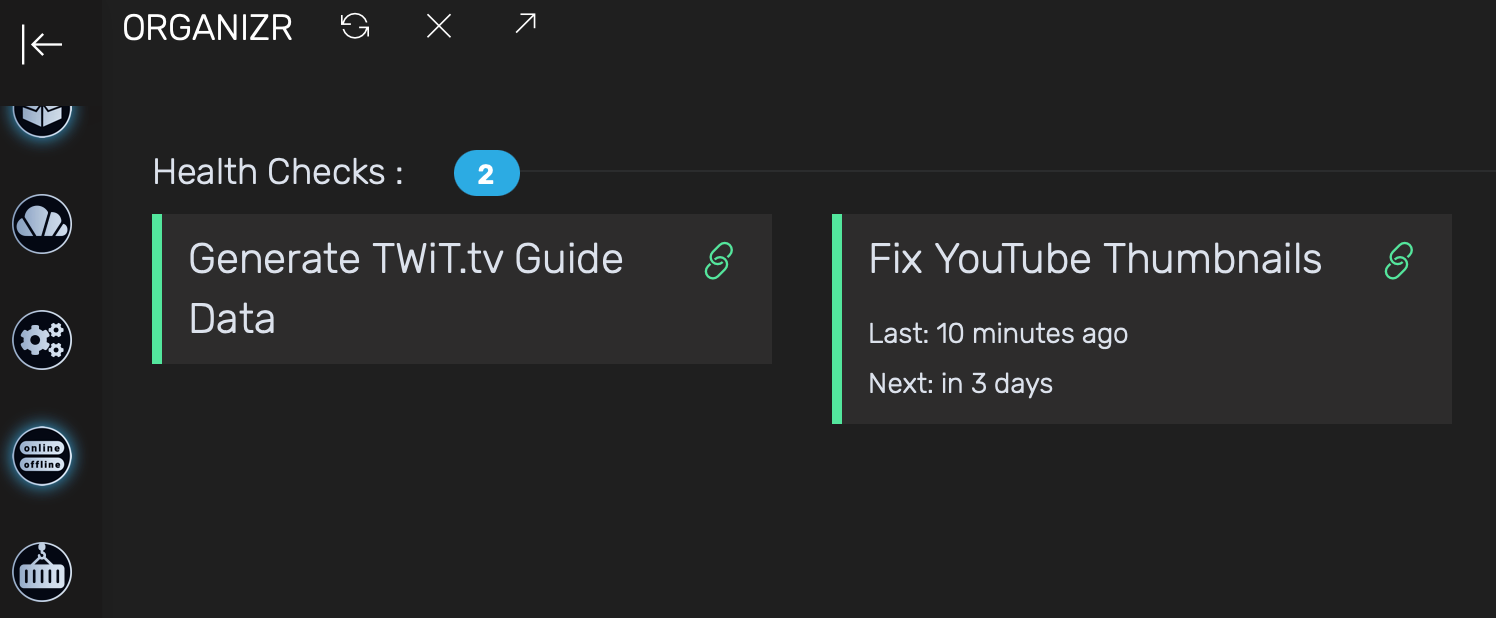
I also like the Healthchecks.io plugin, I got it integrated into an Organizr "home page:"

Nice find! I didn't realize that HEALTHCHECKS was "our" healthchecks.io. Sweet.

Ha! And I'd figured you chose it specifically because of its slick integration with Organizr. :wink:

Organizr really is a great and thoughtful tool. I added bookmarks for other smarthome server stuff that I monitor and manage, into a category of its own.

All of these used to be in a bookmark group that would open many browser tabs. This "unified dashboard" approach is much more appealing.

I have several additional recommendations for Organizr-based toolkits (utilizing Docker via Portainer of course :wink:):

These are utilities you may be using already, but running them via a WebUI makes them very nice for remote use (especially via Tailscale).

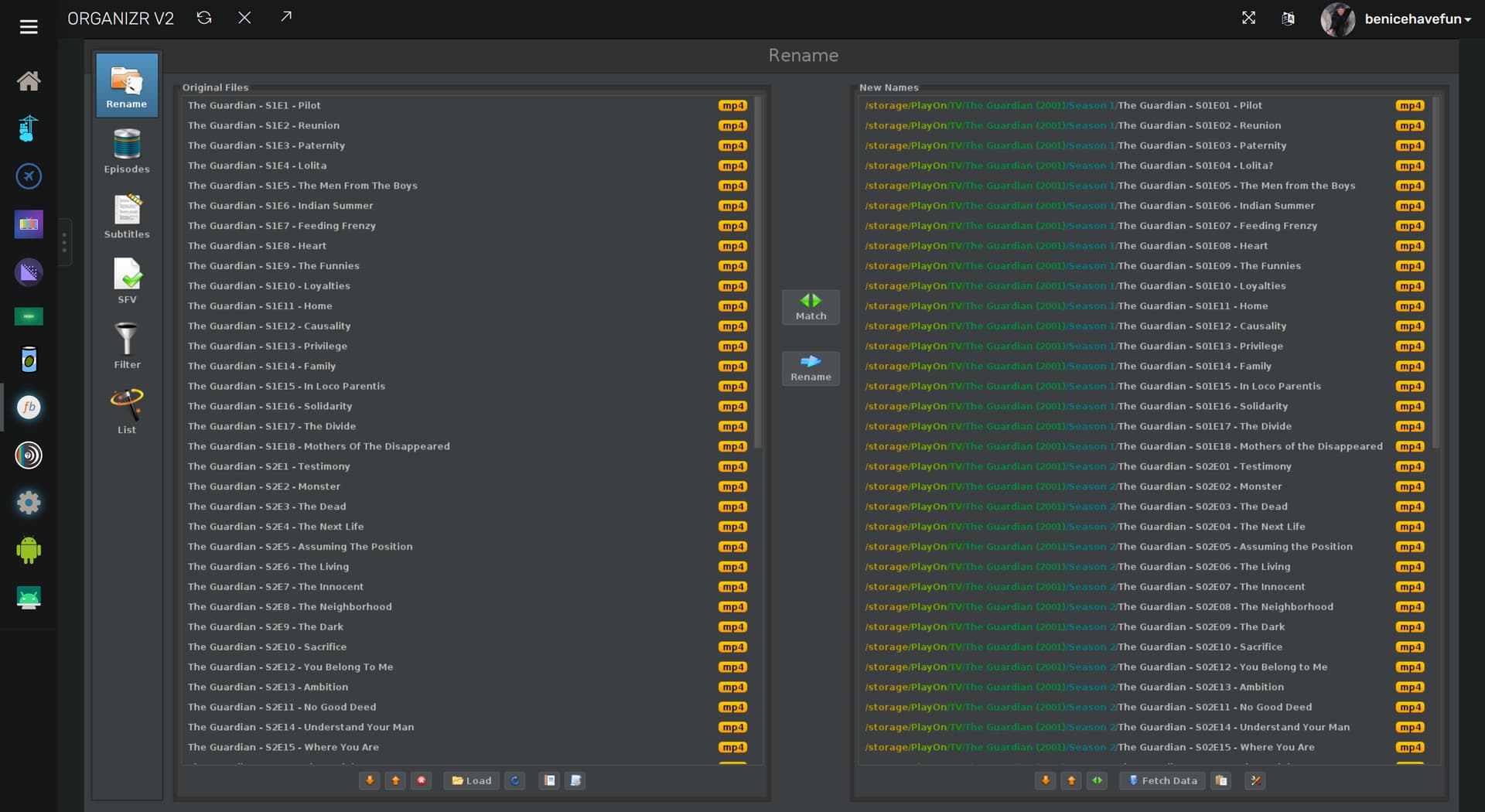
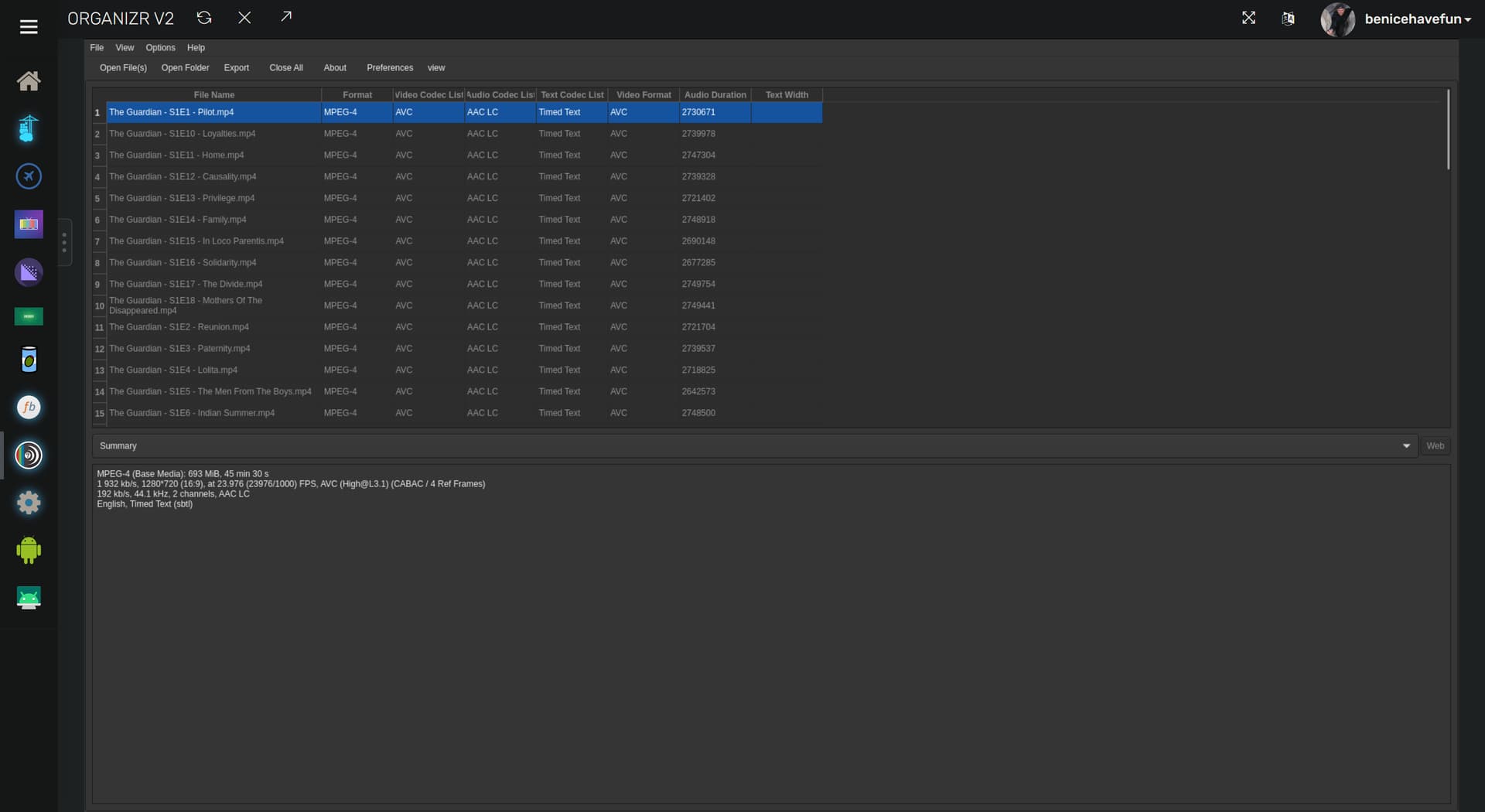
The first is FileBot, which is great for bulk file renaming:

Here's my recommended docker-compose:

version: '3.9'
services:
  filebot:
    image: jlesage/filebot:${TAG}
    container_name: filebot
    ports:
      - 5800:5800
    environment:
      - DARK_MODE=${DARK_MODE}
    volumes:
      - ${HOST_DIR}/filebot:/config:rw
      - ${DVR_SHARE}:/storage:rw

And, sample environment variables:

TAG=latest
DARK_MODE=1
HOST_DIR=/data
DVR_SHARE=/mnt/dvr

The second is MediaInfo, a well known and widely used program to list a wealth of details about a given video file:

docker-compose:

version: '3.9'
services:
  mediainfo:
    image: jlesage/mediainfo:${TAG}
    container_name: mediainfo
    ports:
      - 5801:5800
    environment:
      - DARK_MODE=${DARK_MODE}
    volumes:
      - ${HOST_DIR}/mediainfo:/config:rw
      - ${DVR_SHARE}:/storage:ro

environment sample:

TAG=latest
DARK_MODE=1
HOST_DIR=/data
DVR_SHARE=/mnt/dvr

Lastly, here are some good icon images for each you can upload to the Image Manager, since neither has stock Organizr icons:

FileBot:
filebot

MediaInfo:
mediainfo

If you're a regular Organizr user like me, you've probably run into a few WebUIs that don't work in an iFrame. This is often the result of X-Frame or Content-Security headers. I've implemented application-specific workarounds in the past, but these often only function until the next update to that software.

The most recent approach I'm using is the best yet, and it works everywhere -- at least for the WebUIs I want in Organizr, that have been challenging to get working. This approach uses the containerized version of Caddy, so it's easy to install and to use.

This is a reverse proxy approach, so you'll be making whatever WebUI available on a different port, in a form that can be used in an iFrame. Here's the Docker Compose, and a sample CaddyFile that needs to be placed in your bound directory:

version: '3.9'
services:
  caddy:
    # 2025.05.06
    # GitHub home for this project: https://github.com/caddyserver/caddy.
    # Docker container home for this project with setup instructions: https://hub.docker.com/_/caddy.
    image: caddy:${TAG:-latest} # Add the tag like latest or test to the environment variables below.
    container_name: caddy
    ports:
      - ${HOST_PORT}:${CADDY_PORT} # Reverse proxy port defined in Caddyfile.
    volumes:
      - ${HOST_DIR:-/data}/caddy/Caddyfile:/etc/caddy/Caddyfile # Add the parent directory on your Docker host you'd like to use.
    #extra_hosts:
      #- host.docker.internal:172.17.0.1 # host.docker.internal is generally not predefined on Linux hosts.
    restart: unless-stopped

Sample env vars:

TAG=latest
HOST_PORT=8020
CADDY_PORT=8020
HOST_DIR=/data

And, a sample Caddyfile:

:8020

  reverse_proxy http://host.docker.internal:8010 {
    header_down -X-Frame-Options
    header_down -Content-Security-Policy
    header_down Content-Security-Policy "frame-ancestors *"
}

Happy Organizring!

I really hate to ask this question, because I always struggle mightily with networking between my nas/containers/local/remote stuff. But I love using organizr while I'm at home on my local network, and yet I just can't seem to make it work connecting remotely over tailscale. The gist of the issue is that I can see the organizr homepage just fine while connecting remotely over tailscale, but I can't seem to get any of the tabs to connect to the right ip address no matter how I set it up.

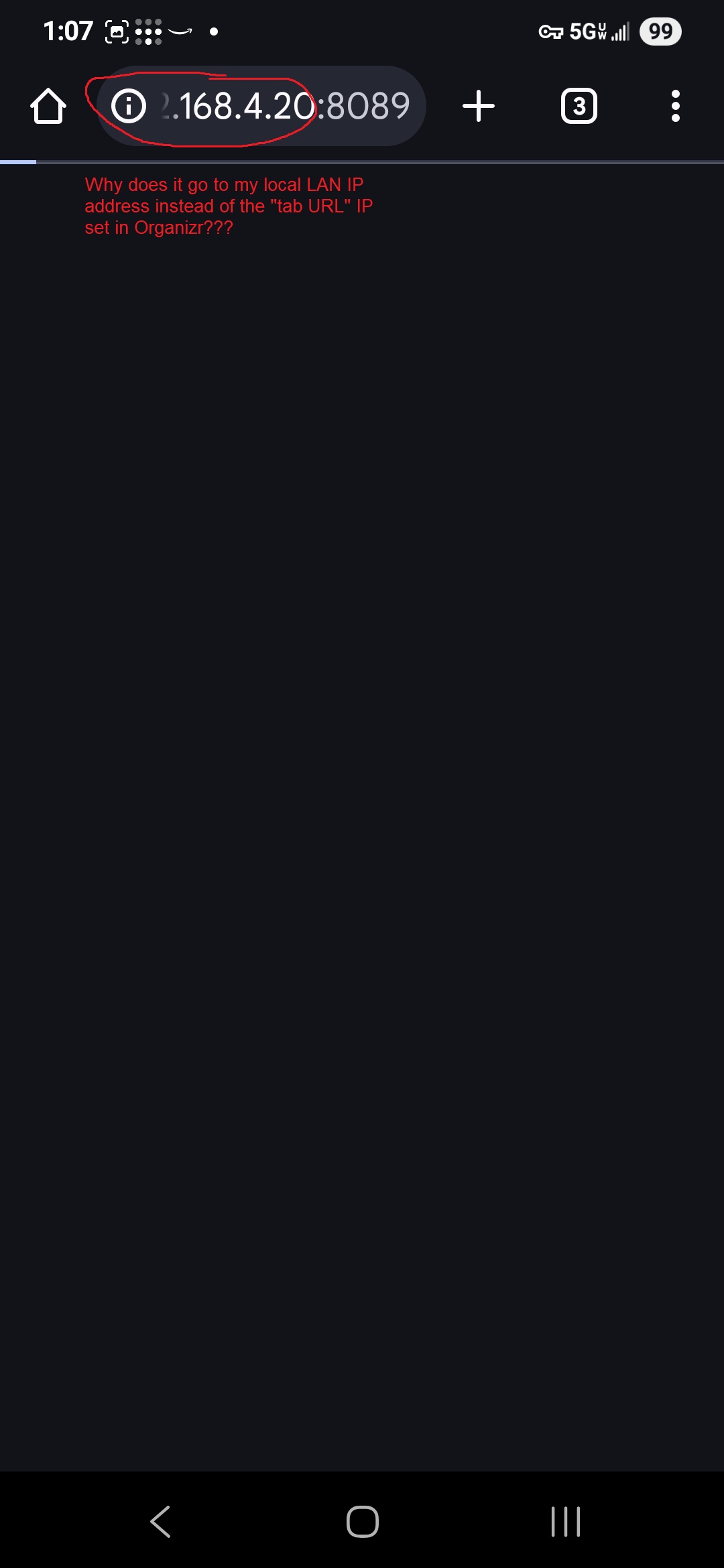
For example, my local NAS IP address is 192.168.4.20, and I'm running organizr on port 8055, so when at home I can just go to 192.168.4.20:8055, and I can access all of my webui's without issue (whether they are set as the "tab URL" or "tab local URL"). But when I am connected remote over tailscale, I can see organizer at "http://my_nas_tailscale_ip:8055", but now none of the tabs will work. And this is with setting the same IP for the "tab URL" as the one I connect to for organizr. And if I hit the little diagonal arrow to pop out that tab, it always redirects to the tab local URL, even when I am remote. Can anyone point me in the correct direction at all?

Tailscale is at its best when it's installed everywhere you can, as this way whether you're home or away you can use MagicDNS and hostnames for everything (little or no need to use IP addresses, especially not two different IP addresses for local or Tailnet).

But whether you use MagicDNS or not, you should be able to do what you're after. The first question is, do you have all your WebUIs setup to load in an iFrame?

The next is, can you give me some example URLs you're using in your Organizr tabs (maybe a screenshot or two)?

And the last is, do you have a subnet router setup on your Tailnet?

In your master Tailscale settings checkout a setting called subnet routes. Under machines in Tailscale settings choose your nas then edit route settings and enable subnets. Just use chatGTP if you run into problems.

What this does, when your nas is advertising its subnet you will be able to use your local LAN ip and/or the tailnet ip addresses to reach any device on your LAN from your remote device. This includes devices that do not have tailscale installed on them for example Hdhomerun, printers, iot.

Once setup you would use local 192.168.4.20:8055 even when remoting in from a Tailscale connected device.

I guess I would be a little concerned about exposing my entire LAN to the outside world. I'm not as worried about my NAS, because it really only contains things I'm not worried too much about, such as Channels, Plex, *arr stuff. And I'm obviously not great at the network security stuff.

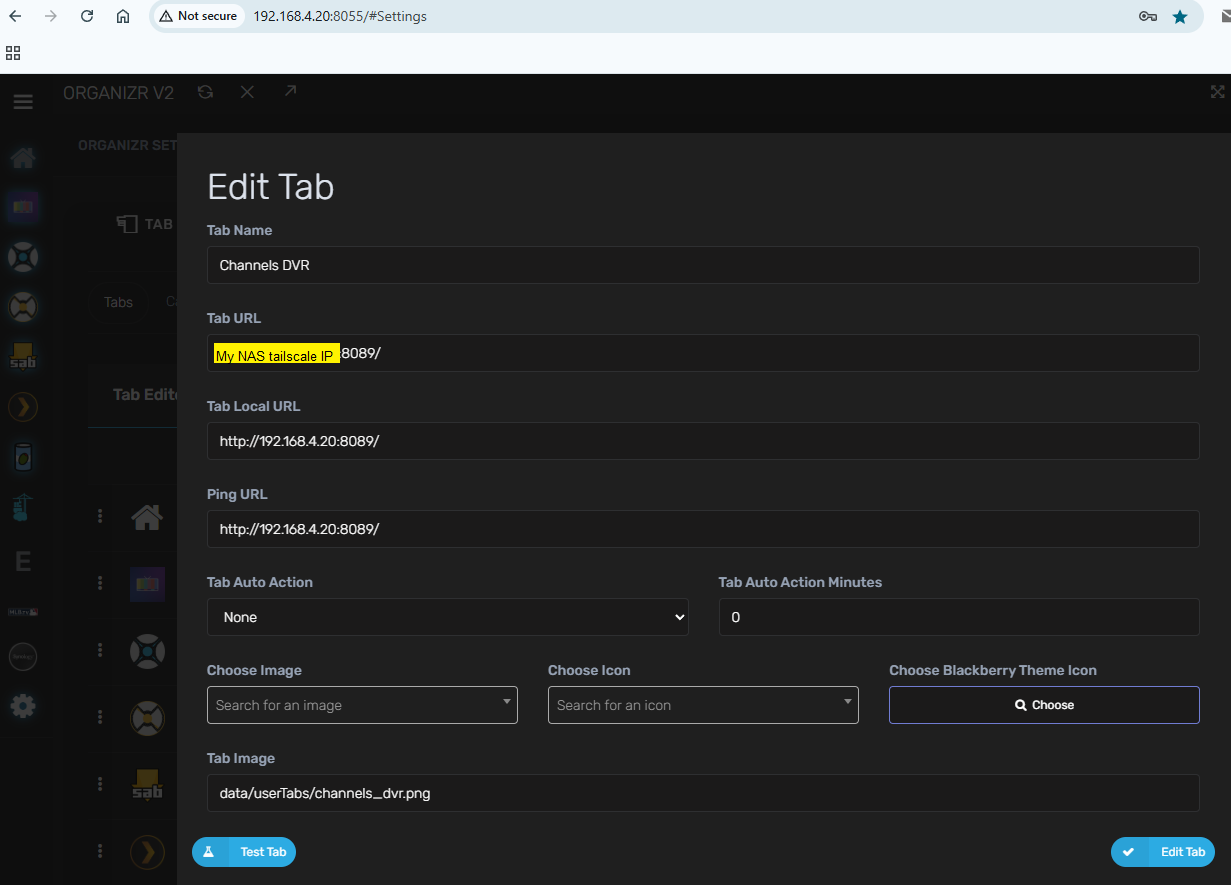
To answer bnhf's question, yes I have everything set up in iFrames. But I am not using magicDNS. Here is a screenshot of my setup for the Channels DVR tab. I have the other tabs set up similarly.

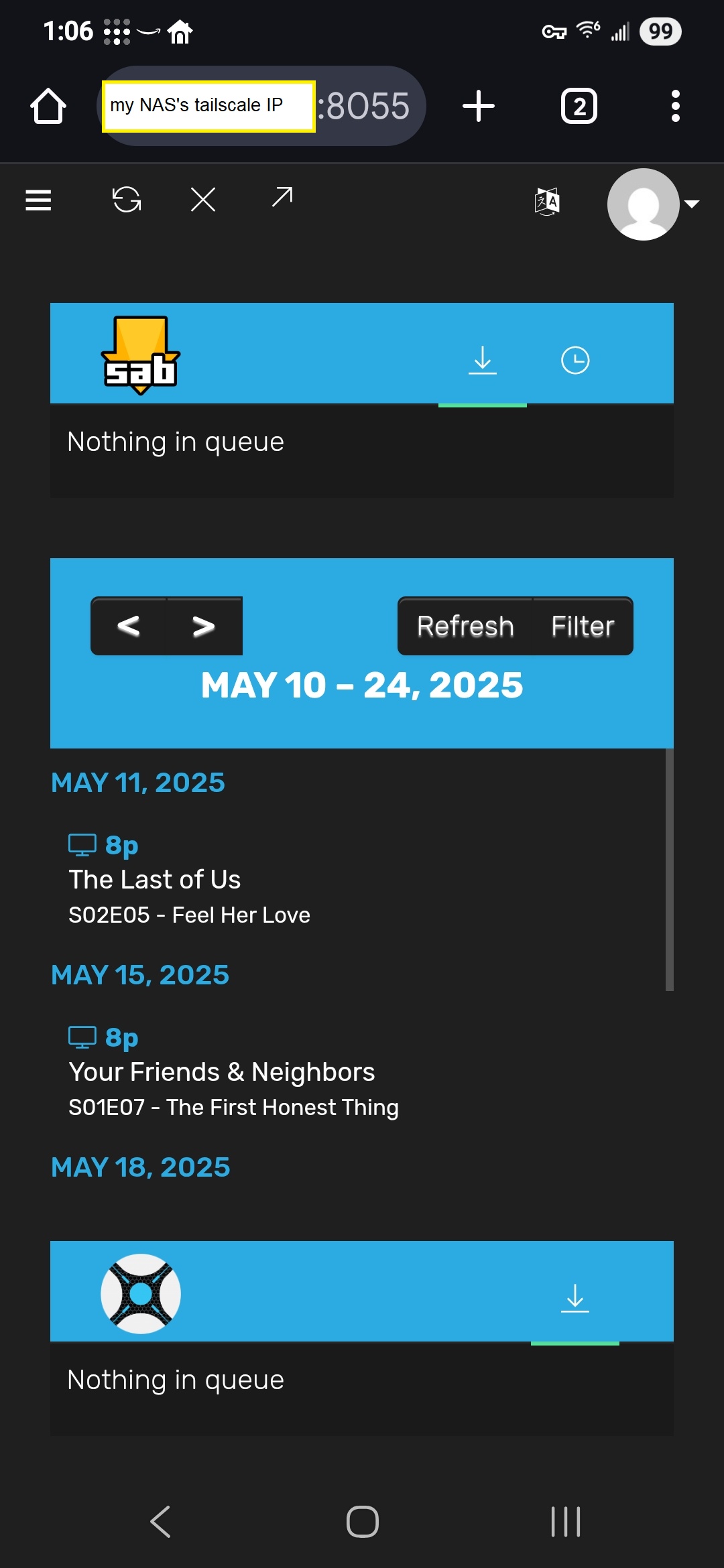
So, when I connect to the tailscale network remotely on my phone, I can access the homepage of organizr just fine by using my tailscale IP for my nas on port 8055. Like so:

But when I hit any of the tabs, I just get a black screen. And when I hit the little "popout" button, it tries to connect to my local IP instead of the tailscale one. I should also note that I can still remotely connect to Channels DVR outside of Organizr at this same point by just going to "my_NAS_tailscale_IP:8089". I just can't seem to get that redirection to work properly inside of Organizr.

I'd try removing the Tab Local URL and Ping URL values -- leave both blank. Organizr probably thinks you're local even when you're not. As long as you're using iFrames, and your NAS is using Tailscale, those 100.x.x.x IPs should work even when you're accessing Organizr from non-Tailscale nodes on your LAN.

1 Like

Organizr have that bizarre bug in there for some reason. I too had to remove local url from there. I use tailscale to access that anyways so it's not too bad...

1 Like