RPi support and TVE

I'm well aware of the announcement from January about the end of support for the RPi Channels image on 5/1, but it seems like either I missed something back then or some details have changed in the interim.

At that time I thought it was stated that while the IMAGE was being discontinued the RPi was still going to be supported (though no longer recommended) as a Channels server using a standard Linux distro. Specifically "You can still host your Channels DVR Server on your Pi using the normal Linux instructions with Raspbian installed on your Pi." I understand that things like transcoding were dropping, but that was not an issue for me.

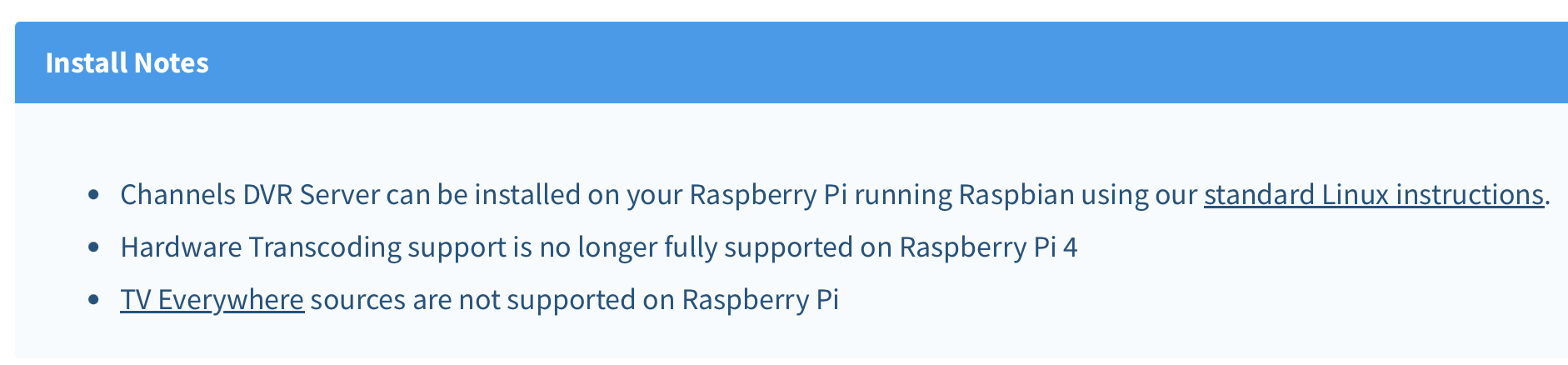
However, now that I finally got around to attempting to set up a Channels server on a Pi with Raspbian I see new information on the server hardware page saying "[TV Everywhere] sources are not supported on Raspberry Pi."

Where did this come from? I have heard no mention of dropping TVE in the January announcement or anywhere since then.

It also states that there will be no future updates past 5/1, but I assume that means only if you continue to use the image, correct?

Edit: I also see that the TVE support page contradicts this: "TV Everywhere sources are supported in Channels DVR Server installed on all Windows, Mac, and Linux based computers. This includes the Raspberry Pi 4 or equivalent."
It could be related to hardware transcoding? While the Pi4 has hardware acceleration, the Pi5 does not. Or perhaps you have not yet installed chromium from your distro's repository, which is required for TVE?

(I suppose you will probably have to wait for a developer to respond with the actual reason. You may want to submit diagnostics from your Channels install on Pi and post the reference ID so there is more detail they can refer to.)

Thanks for the response. I haven't installed it yet, I'm reacting to what's said on the website. In one place it says the Pi won't support TVE (which I never heard before) and in another it says it does.

The Pi image supported TVE, and the regular Linux install supports TVE, so there is no reason to assume that a regular Linux install on a Pi will not support TVE. (And since it's essentially minimal Debian, I have since migrated all of my Pi devices to PiOS Lite.)

I am not assuming anything, I am asking about this:

One way to know for certain:

  • Flash the minimal OS of your choice
  • Update it
  • Install Chromium
  • Install Channels
  • Attempt to add a TVE source

There is no knowledge as certain and profound as first-hand knowledge. :smirk:

True but that's a lot of work to find out it doesn't work, or worse that it DOES work and then when it stops working the developers say it wasn't supposed to work to begin with.

It's maybe 30–60 minutes and a USB flash drive. In the time spent hemming and hawing about whether it might work, you could have already found out.

1 Like

The most popular cable providers block Linux on the Pi from logging in, so there's nothing we can do to support that situation. If it works for you, that's fine, but if it doesn't, we aren't able to spend any effort to fix it.

Interesting, thank you. So this is not a change? TVE worked fine for me on a Pi with your image so when I saw the statement on the hardware page that TVE was not supported I took this to mean it would not work going forward with a straight Linux install. And as I pointed out the TVE page on your site still specifically says TVE is supported on RPi.

We are no longer putting additional effort in to testing TVE on the Pi or providing assistance if it doesn’t work for someone.

You can run an unsupported configuration if you want, we just can’t help you if it breaks.

So FYI TVE on a Pi with Channels installed via the standard Linux instructions works fine for me. I must be one of the lucky ones. The hardest part was getting the Pi to recognize more than 2TB of my 5TB USB drive, but once I got that working everything was golden.